Water Mitigation Steps After Roof Leaks During Tampa Hurricane Season
A roof leak during Tampa hurricane season can soak ceilings, insulation, and drywall in minutes. Here are the water mitigation steps that stop the damage from spreading.
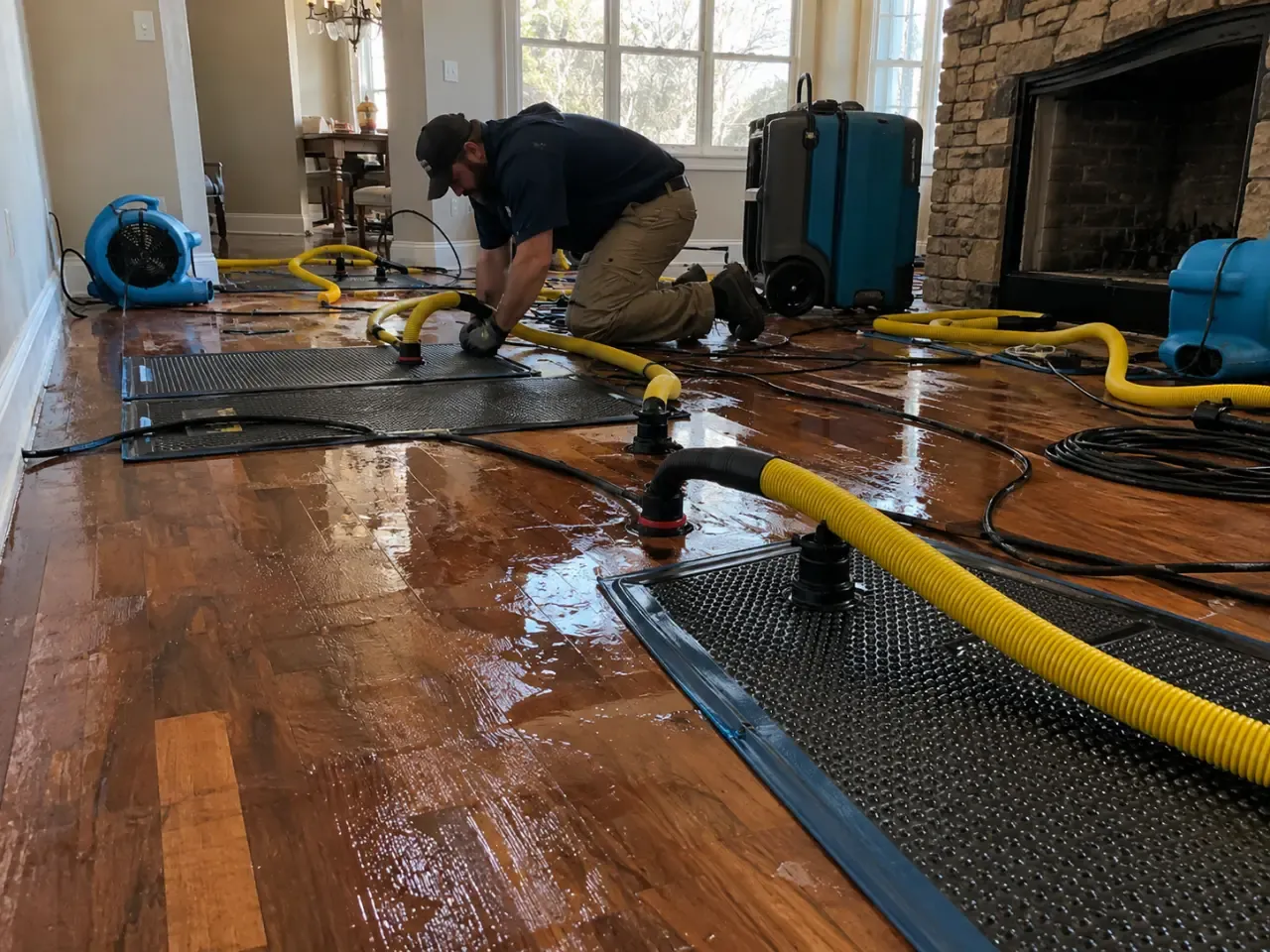
After a roof leak during Tampa hurricane season, the first thing you do is stop the water from spreading: move furniture and electronics off the wet floor, put buckets under active drips, and call a water mitigation crew to extract standing water and start structural drying within 24 to 48 hours. Everything else - insurance, repairs, mold prevention - follows that order. This post walks through the exact water mitigation steps we run after a Tampa storm damages the roof, from the first hour to the final moisture reading.
What to do first after a roof leak in Tampa
What to do after a roof leak in Tampa starts with containment, not repair. You cannot safely tarp a roof in 45 mph gusts, so the priority is keeping the water that already got in from reaching more of the house.
Do these five things in the first 30 minutes:
- Kill power to any ceiling fixture that is dripping or sagging. A wet ceiling can hold 20 to 30 gallons of water before it fails.
- Move furniture, rugs, and electronics at least 6 feet from the wet zone.
- Place buckets and towels under active drips, and lay plastic sheeting over carpet you cannot move.
- Poke a small drain hole in a bulging ceiling with a screwdriver - over a bucket - so the water releases in one spot instead of collapsing a whole sheet of drywall.
- Photograph everything before you touch it. Insurers want the pre-cleanup condition.
Once the active dripping is managed, get a crew on site. Our team runs emergency water extraction Tampa around the clock during storm season, and the sooner the standing water is out, the less of your ceiling, insulation, and hardwood has to be replaced.
How quickly should roof leak water be removed in Tampa?
Roof leak water in Tampa should be extracted within 24 hours and fully dried within 3 to 5 days. Mold can begin colonizing wet drywall and insulation in 24 to 48 hours at the temperatures Tampa holds in September and October - 85 to 92°F with 70%+ humidity is close to ideal mold weather.
That timeline is tighter than most homeowners expect. A slow drip that runs overnight can soak through a ceiling, into the attic insulation, and down inside a wall cavity before you notice the stain. By the time the paint bubbles, the framing behind it has been wet for hours.
We use moisture meters and thermal imaging to find water that has traveled sideways from the leak point. Water rarely drops straight down. It follows joists, runs along top plates, and shows up 10 feet from where the roof failed.
The water mitigation steps we run after a Tampa storm damages the roof
Water mitigation steps after a roof leak in Tampa FL are a sequence, not a single service call. Skipping a step is how a $2,000 dry-out turns into a $14,000 rebuild.
1. Emergency stabilization and water extraction
We start by stopping any water still entering - tarping the roof if the wind has dropped, or sealing the breach from inside if it has not. Then we extract standing water with truck-mounted and portable units, pulling 30 to 50 gallons out of a typical flooded ceiling and attic in under two hours.
2. Removal of unsalvageable materials
Saturated insulation, wet drywall below the leak line, and carpet padding that has been wet more than 24 hours come out. Insulation loses its R-value once it is soaked and will not dry in place. We bag and remove it, then treat the framing.
3. Structural drying and dehumidification
This is the step that decides whether you get mold. We set commercial air movers and LGR dehumidifiers to pull moisture out of framing, subfloor, and drywall. A typical Tampa home needs 8 to 14 air movers and 2 to 4 dehumidifiers running 3 to 5 days. We monitor with daily moisture readings and do not pull equipment until the framing reads within 2% of a dry standard.
You can read more about how we run that phase on our structural drying Tampa page.
4. Antimicrobial treatment
Any cavity that stayed wet past 48 hours gets an antimicrobial application. This is not a substitute for drying - it is insurance against the spores that already landed.
5. Documentation for your claim
We photograph moisture readings, log equipment placement, and produce a drying report your adjuster can use. That report is often the difference between a covered claim and a fight.
Drying a home after hurricane rain enters through the roof
Drying a home after hurricane rain enters through the roof is different from drying a clean supply-line leak. Storm water carries roof grit, shingle granules, and sometimes attic debris, so the affected area is treated as contaminated until it is cleaned.
Two things matter most in a Tampa home:
- Attic ventilation. A Tampa attic can hit 130°F in the afternoon. That heat drives moisture into the living space if the attic is not dried in parallel with the rooms below.
- Wall cavities. Blown-in insulation and paper-faced drywall hold water against the studs. We drill small access holes and dry the cavity rather than tearing out the whole wall.
If the leak was large or the water sat more than two days, we also check for mold growth behind baseboards and inside the HVAC return. We handle that with mold remediation Tampa once the structure is dry.
What to watch out for after a Tampa tropical storm
Water damage prevention after a Tampa tropical storm is mostly about catching the second problem - the one that shows up a week later.
Watch for these:
- A musty smell in one room. That is mold, not humidity. It usually means a wall cavity or the attic is still wet.
- Paint or texture bubbling on the ceiling. Water is trapped above the drywall and will keep spreading.
- Soft spots in the floor near an exterior wall. Subfloor and joists absorb water that ran down inside the wall.
- A spike in your power bill. A wet HVAC return or duct can make the system work harder for weeks.
- Granule loss on shingles. If you see bare spots after the storm, the next rain will find them.
We also see this pattern in older neighborhoods. In Water Mitigation in Seminole Heights, the 1920s bungalows have original plank sheathing and no house wrap, so storm water that gets past a lifted shingle spreads through the roof deck faster than it would in a newer build.
When to call a professional water restoration company after a roof leak in Tampa
Call a professional water restoration company after a roof leak in Tampa when any of these are true: the wet area is larger than 10 square feet, the ceiling is sagging, water reached insulation or a wall cavity, the leak happened more than 24 hours ago, or you can smell mustiness. Those are the conditions where a shop vac and a box fan will not finish the job.
Our team handles the whole sequence - extraction, material removal, drying, antimicrobial, and documentation - under one roof. We serve homeowners across the city, from Water Mitigation in South Tampa to the newer builds out near Tampa Palms, and we work directly with your insurance adjuster so you are not translating between two contractors.
If you are not sure whether your situation qualifies, call us and describe what you see. We will tell you honestly whether it is a DIY dry-out or a job that needs equipment.
Frequently Asked Questions
What should I do first after a roof leak during Tampa hurricane season?
Cut power to any wet ceiling fixture, move belongings out of the wet zone, and put buckets under active drips. Then call a mitigation crew. Do not climb the roof during a storm - tarping waits until winds drop below 40 mph.
How quickly should roof leak water be removed in Tampa?
Within 24 hours. Extraction should start the same day, and full structural drying takes 3 to 5 days. Mold can start growing in Tampa's warm, humid conditions in as little as 24 to 48 hours.
Who handles water damage cleanup after a Tampa storm roof leak?
A licensed water mitigation and restoration company handles it - extraction, material removal, drying, and antimicrobial treatment. A roofer fixes the roof, but the water inside the house is a separate trade. We coordinate both.
Can a roof leak cause mold if it is not dried quickly?
Yes. Wet drywall, insulation, and wood framing in a Tampa home can grow mold within 24 to 48 hours. Visible mold usually appears within 5 to 10 days if the structure stays above 60% moisture content.
Does insurance cover water mitigation after hurricane-related roof damage?
In most Florida policies, yes - sudden storm-driven roof leaks are covered, including extraction and drying. Damage from long-term neglect or repeated leaks is often excluded. We document everything so your adjuster has what they need.
Get help with Water Mitigation in Tampa
If a roof leak has already put water in your ceilings, walls, or attic, the clock is running. Our team provides Water Mitigation Tampa FL with same-day response during hurricane season, and we handle extraction, drying, and documentation in one visit.
Call (813) 588-6476 and we will get a crew to your door.